UAE E-Invoicing with Peppol: What Businesses Need to Know
A plain-English guide to the UAE's e-invoicing programme: how the Peppol model works, who is affected, what changes for your invoices and how to get ready.
The UAE is moving from PDF and paper invoices to structured e-invoicing. For most businesses this is a major change to how invoices are created, sent and reported to the Federal Tax Authority (FTA). Here's what it means and how to prepare.
This article is general guidance, not tax advice. Rollout dates and requirements are set by the UAE Ministry of Finance and the FTA. Always check the latest official announcements.
What is e-invoicing?
An e-invoice is not a PDF sent by email. It's a structured data file (based on standards such as UBL XML) that software can read automatically. The data is exchanged between businesses through accredited providers and shared with the tax authority.
How the UAE model works: Peppol's "5-corner" approach
The UAE uses a model based on the Peppol network:
- The supplier creates the invoice in its system.
- The supplier's Accredited Service Provider (ASP) validates it and sends it over Peppol.
- The buyer's ASP receives it.
- The buyer gets the invoice in its own system.
- The FTA receives the tax data reported by the service providers.
The key point: businesses don't connect to the FTA directly. You work through an accredited service provider, or a platform that connects to one.
Who is affected?
The programme applies broadly to business-to-business (B2B) and business-to-government (B2G) transactions, with a phased rollout that starts with larger businesses. Make sure you know which phase you fall into and when you need to appoint a service provider.
What changes for your business
- Invoice data must be complete and structured. Missing fields such as TRNs or tax codes will cause rejections.
- Validation happens before delivery. Invoices that fail checks don't reach your customer.
- Your accounting or ERP system must produce the required format, or connect to a platform that does.
- Records and audit trails become digital and centralised.
How to get ready
- Review your invoicing process and the systems that create invoices.
- Clean your master data: customer TRNs, addresses and product tax codes.
- Choose an e-invoicing solution that connects to an accredited service provider.
- Test with real invoice scenarios: credit notes, multiple currencies and multiple entities.
- Train your finance team on rejections, corrections and reporting.
What a good e-invoicing platform should offer
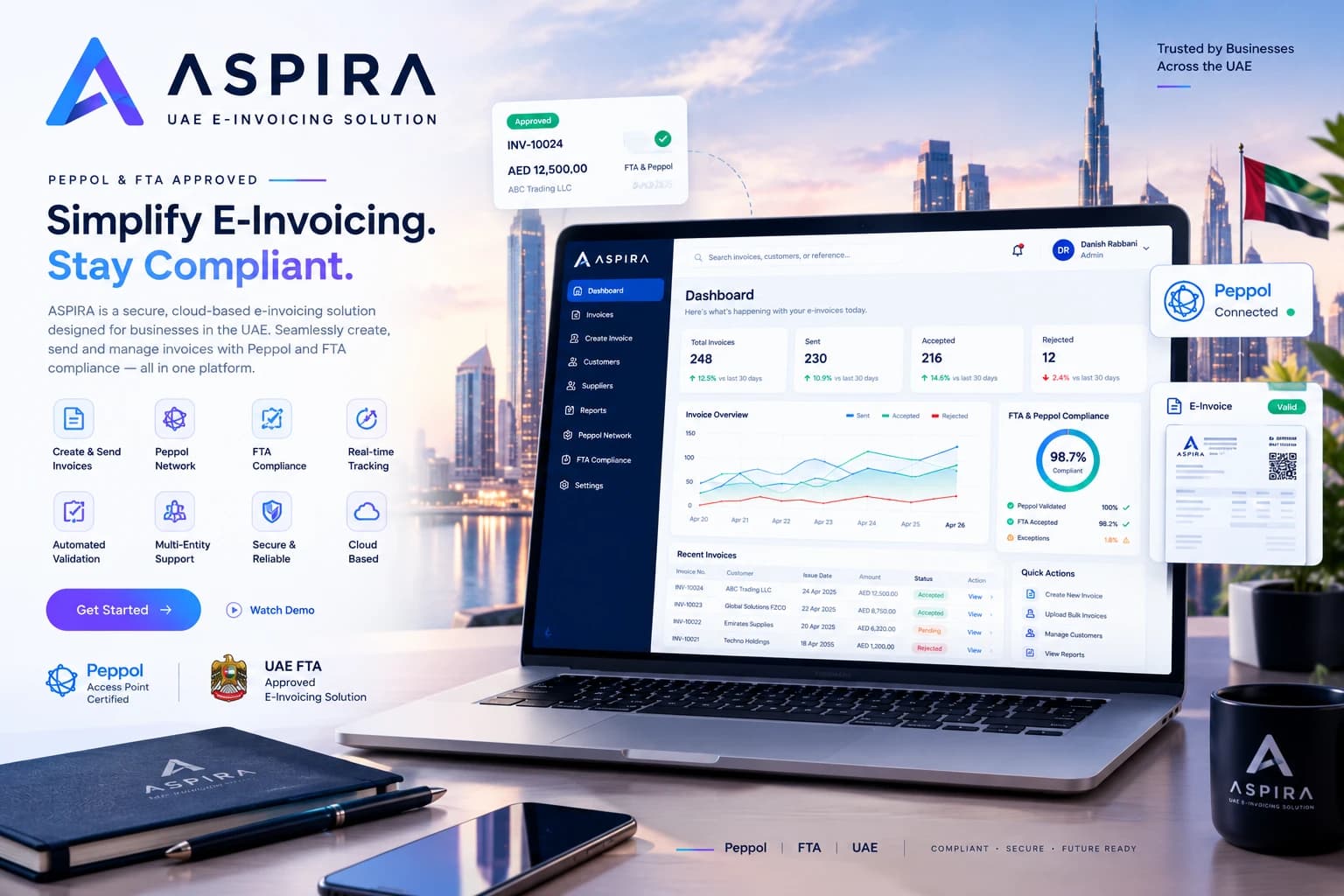
Based on our work on Aspira, a UAE e-invoicing platform, look for:
- Creating, sending and receiving invoices over Peppol
- Automated validation against FTA rules before submission
- A compliance dashboard showing accepted, pending and rejected invoices
- Multi-entity support for groups with several companies
- Bulk upload and ERP integration
- A secure, cloud-based setup with full audit history
Need a custom e-invoicing solution?
Whether you need a standalone e-invoicing platform or want to connect your existing ERP to Peppol, our team can help. Book a free call or send us your requirements.